In March we made a trip out to Chicago for a CocoaConf. On most of our trips for CocoaConf, we send a delegation, and we were very happy that it worked out for us all to go this time!
We all help out in various aspects for a Cocoaconf, but usually most of the work is during initial set up and then teardown (during the conference we only need a handful of people there to keep things running). So while the conference is going on, the rest of us who aren’t busy helping hang out at the hotel, catch up on laundry, or (most exciting :) go sightseeing. The Lord has allowed us to see some pretty neat things on our trips for CocoaConf — since the conferences are held all over the country, we get the opportunity to explore lots of interesting and fun places.
This time, we visited Wheaton College!
(I'm not sure if that counts for typical sightseeing, but it's quite the sort of thing we like to do :)
We had a few potential places to see lined up, one of which was a museum at the Billy Graham Center. But then we learned the Billy Graham Center also houses an archive containing materials from many American missionaries. Our family reads lots of missionary biographies, and we were very excited to be able to see some of the original writings of missionaries we had read about!
So Mom got in touch with the folks at the Billy Graham Center, and arranged a time for us to visit.
 |
It was exciting just to be at Wheaton, as some of our family's favorite missionary
heroes, Jim Elliot and Nate Saint, were students here in the 1940's. |
After we arrived, Mom took the little boys to see the museum, leaving Hannah, Joanna, Bekah, Susanna, Sammy, and me in the Manuscript Reading Room.
(I think we all liked the fact that we got to be in a room called the
Manuscript Reading Room — it just sounded so scholarly.)
Before we left for the Billy Graham Center, we pulled up their catalog page on their website, and we selected some collections of documents to look through. Everything was in numbered folders, packed in labeled file folder boxes. We only went through one box at a time, to keep from mixing things up.
First we looked at a box of materials related to/written by John and Betty Stam (missionaries in China).
 |
| John Stam's journal |
We were able to take pictures of whatever we liked (as long as it wasn't restricted, and we didn't look at anything that was). Before we were through we had succeeded in draining the batteries and/or filling up the camera rolls on all of the four iPhones/iPods that we had brought with us. :)
 |
| Betty wrote this poem for her father (Charles Ernest Scott) |
At first we were all rather nervous, and proceeded with all due ceremony — I as the oldest
very carefully opening the first box and
very carefully passing out the folders to the others who sat
very carefully watching me. All done
very carefully.
 |
Joanna and Hannah
|
After a while we got over being nervous and abandoned further ceremony (while trying to maintain the aforementioned carefulness).


 |
| This was my favorite of the many poems in the Stams' folder. |
Next we looked at some things from John and Isobel Khun (missionaries to the Lisu in China).
 |
| Isobel and her two children, Kathy and Danny. |
 |
| Letters between John and Isobel before they were married. |
 |
| Joanna and Bekah reading some Khun letters. |
We also got to see a few things from Hudson Taylor (mostly scans of documents related to a trip he took to the US).
I was very excited to see some things from Hudson Taylor, but I had a hard time reading his (lovely :) cursive handwriting and didn't think to take more pictures for those at home who could! I did get a nice picture of his signature:
 |
| Suby |
Last of all we looked at some things from Jonathan and Rosalind Goforth (missionaries in China in the late 1800's and early 1900's). We hadn't really planned it, but all of the missionaries whose writings we looked at were from China.
Another thing we hadn't planned was the order in which we looked at (something), and we ended up saving the best (or should I say
biggest :) for last! The Goforths' manuscripts were close to twice as many as any of the others that we saw that day.
 |
| The manuscript for Goforth Of China |
 |
| This page made me smile. :) |
 |
We got to look at the manuscripts for several of Jonathan and Rosalind Goforth's books
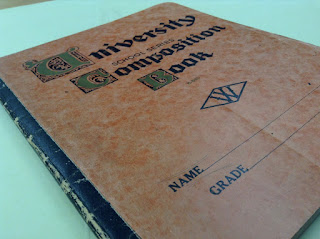
— several of them were handwritten in (very old!) composition notebooks
 |
We had previous read this story (How "Old Autocrat" Was Won By A Sketch)
in Rosalind Goforth's book Miracle Lives of China, and Joanna found
the manuscript for it — in Rosalind's handwriting! |
|
 |
Looking at the manuscript for a book by Jonathan Goforth about
the Boxer Rebellion. |
While we were busy being fascinated upstairs, Mom and the boys enjoyed looking around the museum downstairs.
 |
| The original score for the hymn "The Ninety and Nine" |
They also took a spin around the Wheaton College campus...
We finished up at the archives around 5:30 pm. We spent about four hours there, but I'm quite sure we could have spent the whole day and had plenty to keep us busy! We had an amazing time and we're very grateful for the opportunity!
 |
| We grabbed a selfie before leaving (minus Suby) |
Like I said earlier, our family reads lots of missionary biographies. It has been a tremendous blessing to us — to me personally, to hear and read the stories of great Christians of the past, and to see “at a glance,” so to speak, what God did in and through them. It was wonderful to able to see an touch the letters and journals of some of the heroes of the faith that we’ve read and heard of so much before.
One thing I’ve seen many times in the lives of many great Christian men and women is their relationship with Jesus. It came first.
First they learned to walk with God, to love and obey Him. That relationship was central in everything else they did. That’s what made them what they were.
 |
From the book Borden of Yale '09 — William Borden was the son of a Chicago millionaire
who had dedicated his life to being a missionary to Muslims. He died in Cairo,
where he had gone to study Arabic, at the age of 26. |
I’ve had to continually remind myself that Hudson Taylor, or David Brainerd, or William Borden, or any other Christian I read about, wasn’t just an extraordinary person. Each of them was a normal person that surrendered themselves to an almighty God, and
He worked in them and through them. And that’s exciting, because that’s something that all of us who love the Lord can do too! We can have that same relationship with Jesus, and experience the same love and joy and strength —
His love,
His joy, and
His strength. We might never end up in the Amazon or in Shanghai, we might never be martyrs, we might never have books written about us, but that isn’t the point, is it? The point is that God is glorified, and He is glorified when we surrender to Him and let Him work in us. And God will take care of the rest.
Well, I don’t know about you, but if I end up in Chicago again, I think I know where I might be spending some time! :)
Wherefore seeing we also are compassed about with so great a cloud of witnesses,
let us lay aside every weight, and the sin which doth so easily beset us,
and let us run with patience the race that is set before us,
Looking unto Jesus the author and finisher of our faith;
who for the joy that was set before him endured the cross,
despising the shame,
and is set down at the right hand of the throne of God.
Hebrews 12:1-2


